
Banaba and Mulberry: Two Botanicals Aimed at the After-Meal Spike
Two of Gluco Extend's ingredients act on the glucose rise after eating rather than on fasting levels. Here is how, what the meal studies found, and why timing matters.
Why the after-meal spike gets attention
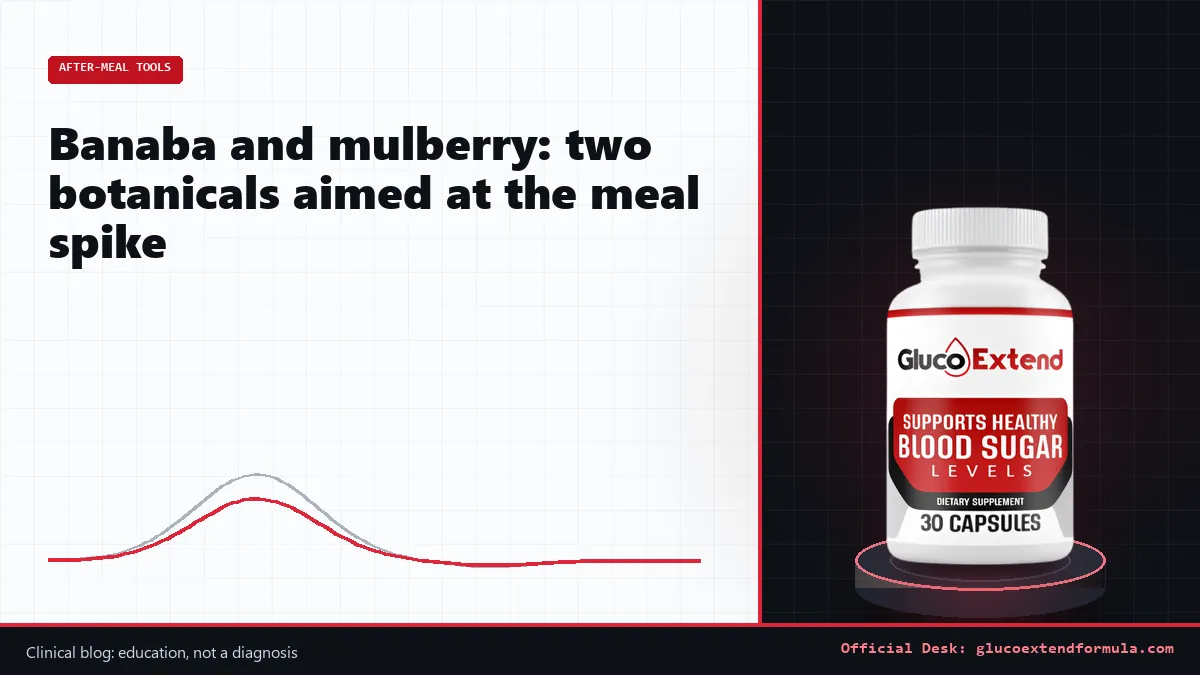
After a meal rich in starch or sugar, glucose in the blood rises, peaks within an hour or so, and falls as insulin moves it into tissues. In people with insulin resistance the peak is higher and the fall is slower. Two botanicals in Gluco Extend, banaba and mulberry leaf, are aimed specifically at that rise rather than at fasting levels, which makes them the most "meal-dependent" ingredients in the formula.
Mulberry leaf: the best-documented of the two
Mulberry leaf contains 1-deoxynojirimycin (DNJ), which inhibits alpha-glucosidase, the enzyme that splits sucrose and starch into absorbable glucose. A 2007 study gave 1 gram of mulberry leaf extract with 75 grams of sucrose to people with and without type 2 diabetes. The glucose rise was smaller, and breath hydrogen rose, showing that some sugar escaped digestion and was fermented in the colon[3]. A DNJ-enriched mulberry powder had similar effects on glucose and insulin in healthy adults[4], and two randomized, placebo-controlled studies of a standardized extract confirmed lower glucose and insulin responses to sugar and starch[5][6]. A 2023 meta-analysis found the clearest benefit on after-meal measures[7].
The catch is in the mechanism: undigested carbohydrate reaching the colon means gas and bloating for some people, and the effect only applies to the meal the extract is taken with.
Banaba: small dose, small studies
Banaba leaf's marker compound is corosolic acid. In a two-week study, adults with type 2 diabetes took 32 or 48 mg a day of an extract standardized to 1 percent corosolic acid, and the 48 mg soft-gel group showed the largest glucose fall[1]. A single 10 mg dose of corosolic acid lowered glucose later in a 75 g glucose tolerance test[2]. These doses are small enough to fit in a multi-ingredient capsule, but only if the banaba is a standardized extract; plain leaf powder contains far less corosolic acid per milligram.
Using them well
Both ingredients should be taken with the meal they are meant to affect, ideally the largest or most carbohydrate-heavy one. Pair them with eating vegetables and protein first and a short walk afterward, which act on the same curve. If you take glucose-lowering medicines, check readings after the meal for the first weeks. In Gluco Extend, both are listed without amounts or standards, so check the bottle's panel for any extract details.
Quick answers
Should mulberry leaf be taken before or with meals?
With the meal, or just before it. It acts on carbohydrate in the gut, so it needs to be there when the food is.
Why does mulberry cause gas?
Because some sugar and starch escape digestion and are fermented in the colon; that is part of how it lowers the glucose rise.
Records cited on this page
Every link opens the original record. The trials tested single botanicals at stated doses and preparations; none tested the Gluco Extend capsule, whose amounts are not published.
- 1Judy WV, Hari SP, Stogsdill WW, et al. Antidiabetic activity of a standardized extract (Glucosol) from Lagerstroemia speciosa leaves in Type II diabetics. A dose-dependence study. J Ethnopharmacol. 2003;87(1):115-117. pubmed.ncbi.nlm.nih.gov/12787964/
- 2Fukushima M, Matsuyama F, Ueda N, et al. Effect of corosolic acid on postchallenge plasma glucose levels. Diabetes Res Clin Pract. 2006;73(2):174-177. pubmed.ncbi.nlm.nih.gov/16549220/
- 3Mudra M, Ercan-Fang N, Zhong L, Furne J, Levitt M. Influence of mulberry leaf extract on the blood glucose and breath hydrogen response to ingestion of 75 g sucrose by type 2 diabetic and control subjects. Diabetes Care. 2007;30(5):1272-1274. pubmed.ncbi.nlm.nih.gov/17303787/
- 4Kimura T, Nakagawa K, Kubota H, et al. Food-grade mulberry powder enriched with 1-deoxynojirimycin suppresses the elevation of postprandial blood glucose in humans. J Agric Food Chem. 2007;55(14):5869-5874. pubmed.ncbi.nlm.nih.gov/17555327/
- 5Lown M, Fuller R, Lightowler H, et al. Mulberry-extract improves glucose tolerance and decreases insulin concentrations in normoglycaemic adults: results of a randomised double-blind placebo-controlled study. PLoS One. 2017;12(2):e0172239. pubmed.ncbi.nlm.nih.gov/28225835/
- 6Thondre PS, Lightowler H, Ahlstrom L, Gallagher A. Mulberry leaf extract improves glycaemic response and insulaemic response to sucrose in healthy subjects: results of a randomized, double blind, placebo-controlled study. Nutr Metab (Lond). 2021;18(1):41. pubmed.ncbi.nlm.nih.gov/33858439/
- 7Cui W, Luo K, Xiao Q, et al. Effect of mulberry leaf or mulberry leaf extract on glycemic traits: a systematic review and meta-analysis. Food Funct. 2023;14(3):1277-1289. pubmed.ncbi.nlm.nih.gov/36644880/
Give Gluco Extend a measured, six-month trial
ClickBank processes the order. Write down a few fasting and after-dinner readings before the first capsule, keep the walk after meals and the vegetables-first plate, save the receipt email, and if your numbers and your doctor see no change by the fifth month, send the bottles back while the window is still open.