
Gluco Extend Supplement Facts: What the Label Shows, What Is Missing and How to Check Yours
No Supplement Facts panel is published for Gluco Extend. This page transcribes everything that is public, explains what a compliant label must show, and gives you a worksheet for the bottle you receive.
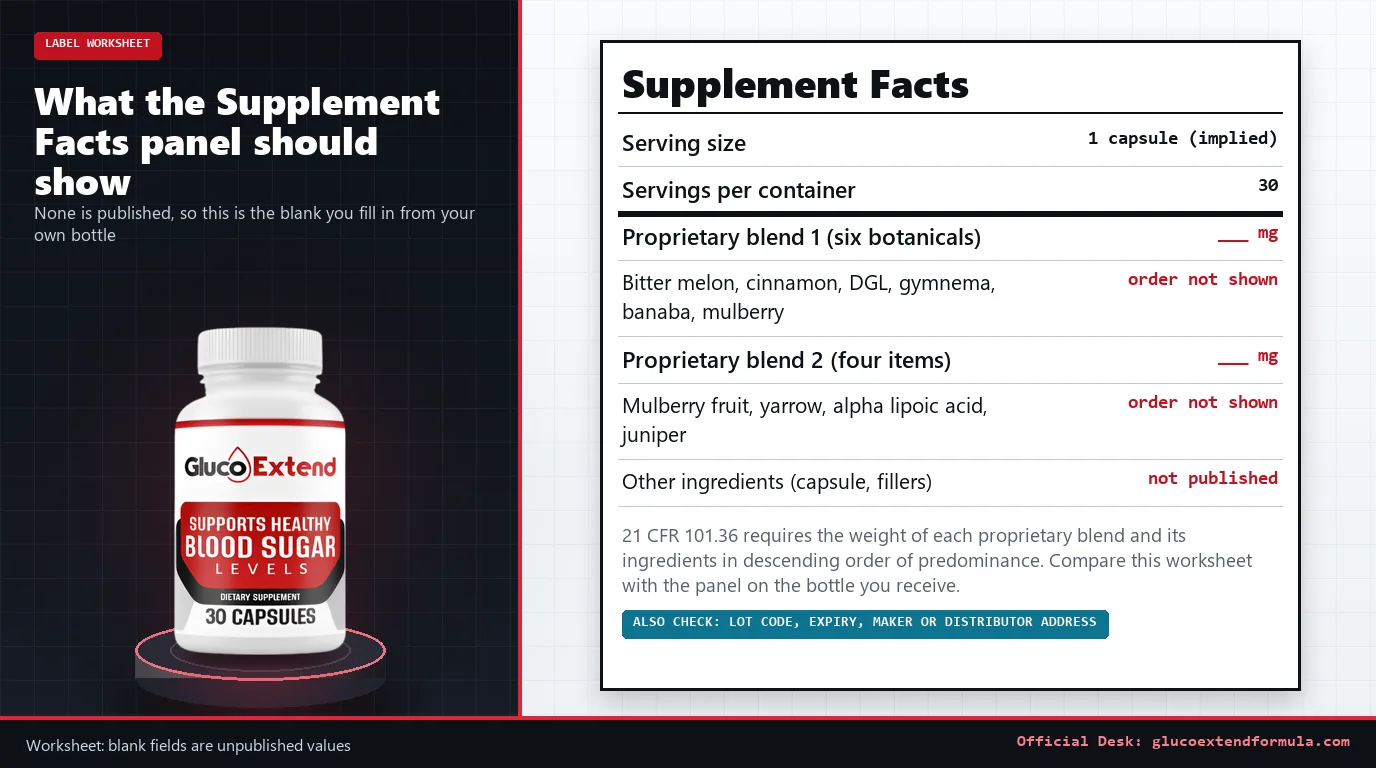
The public label transcript
We searched the vendor's home page, its order page, the support, shipping, privacy and terms pages, every product image on those pages and the ClickBank checkout for a Supplement Facts panel on October 19, 2026. There is none. What follows is everything that can be put together from public sources, arranged like a panel so the gaps are visible.
Bottle front: "Gluco Extend", "Supports Healthy Blood Sugar Levels", "Dietary Supplement", "30 Capsules". Order-page claims: natural formula, easy to use, non-GMO, no stimulants, non-habit forming, gluten free. Footer: "Manufactured in the USA from the finest of foreign and domestic ingredients". Serving size inferred: the packs are sold as 60, 90 and 180 days for 2, 3 and 6 bottles of 30.
What federal rules require on a supplement panel
Dietary supplement labels follow 21 CFR 101.36. For a product built from proprietary blends, the panel has to show the serving size, servings per container, each blend's name, the total weight of each blend per serving, and the ingredients of each blend listed in descending order of predominance by weight[1]. Any vitamin or mineral with a Daily Value has to be listed with its amount. The rest of the label must give a manufacturer, packer or distributor name and a U.S. address or phone number, and an "other ingredients" list for non-active components such as the capsule shell.
The label may use structure and function wording like "supports healthy blood sugar levels", but only with the FDA disclaimer, and it may not claim to diagnose, treat, cure or prevent a disease[2]. Behind the label, manufacturers must follow current good manufacturing practice, which includes specifications for identity, purity, strength and composition and testing to meet them[3]. None of this requires a company to publish its panel online or post its test results, which is why buyers so often meet a product like this one before they meet its label[4].
The two blend headings, read closely
The blend names themselves raise questions. The first is called a "Proprietary Blend of 11+ Plants and Nutrients", yet only six items appear under it on either vendor page. The second is called a "Proprietary Blend of 4 Plants and Minerals", but its four items are two plants, a berry and alpha lipoic acid, an organic compound; no mineral is listed. Taken together the order page names ten ingredients, one fewer than the "11+" claimed in the first heading alone.
There are innocent explanations. Marketing pages often trail behind label revisions, and some blends list sub-components that a web designer shortens. But a buyer should not have to guess. The bottle's panel will show which version is real, and if it does not match either page, that is worth a note to the vendor and a photo for your records.
Capsule arithmetic
Without weights, the only firm limit is physical. Botanical powders fill a standard size 0 capsule at roughly 400 to 500 mg and a size 00 at roughly 600 to 800 mg, depending on density. Gluco Extend's daily serving is one capsule, so everything listed has to fit into well under a gram.
Compare that with doses that showed effects in people: 2,000 mg of bitter melon[6], 1,000 mg or more of cinnamon[7], 400 mg of gymnema extract[8], about 1,000 mg of mulberry leaf extract[10] and 300 mg of alpha lipoic acid[11]. Only banaba, at 32 to 48 mg of a standardized extract[9], is small enough to share. Use the calculator below with the fill weight on your bottle, or a typical 500 mg.
Capsule arithmetic: one capsule, ten names
Concentrated extracts are the one way to shrink a gram-level dose into a smaller space; a 10:1 extract represents ten times its weight in raw plant. If your panel shows ratios such as "10:1" or standardization percentages, the arithmetic improves. If it shows neither, assume raw powder.
Other ingredients, allergens and the capsule itself
The "other ingredients" line is where a label lists everything that is not an active ingredient: the capsule shell (gelatin, which is animal-derived, or a plant cellulose such as hypromellose), flow agents such as rice flour, magnesium stearate or silicon dioxide, and any colors. Gluco Extend's pages say nothing about this line. The order page's claims of "non-GMO" and "gluten free" are the only hints about excipients, and neither tells you whether the capsule is vegetarian.
Allergen labeling matters for two of the named botanicals. Yarrow belongs to the daisy family, so people who react to ragweed, chamomile, chrysanthemum or marigold may react to it. Licorice is a legume, and while DGL is low in glycyrrhizin, people with legume allergies sometimes avoid it. Federal law requires the major food allergens (milk, egg, fish, shellfish, tree nuts, peanuts, wheat, soy and sesame) to be declared on supplement labels, so check the panel for a "Contains" statement as well[4].
Finally, the capsule size itself is useful information. If the bottle states a capsule size or a total fill weight, enter it in the calculator above; if it gives only blend weights, add them together to get the active fill.
How this label compares with a well-disclosed product
To make the gaps concrete, here is what a fully disclosed blood sugar capsule label typically shows, compared with what is public for Gluco Extend.
| Label element | Well-disclosed product | Gluco Extend (public sources) |
|---|---|---|
| Serving size | Stated, e.g. 2 capsules | Implied as 1 capsule by pack pricing |
| Amount of each active | Listed individually in mg | Not published |
| Blend weights | Shown if a blend is used | Not published |
| Extract ratio or marker | e.g. "standardized to 1% corosolic acid" | Not published |
| Other ingredients | Capsule type and fillers listed | Not published |
| Manufacturer or distributor | Name and U.S. address | Not named on the vendor's pages |
| Third-party testing | Seal or CoA on request | None mentioned |
The bottle may well carry more than the pages do. The point of the table is that a buyer cannot know before paying, which is why we recommend reading the panel on arrival and keeping the refund window in mind until you have.
What a certificate of analysis would show
A certificate of analysis is a lab report for one production lot. For a botanical blend like this, a credible CoA would list identity tests for each plant (by microscopy, chromatographic fingerprint or DNA methods), potency for any declared markers (corosolic acid for banaba, DNJ for mulberry, alpha lipoic acid content), heavy metals (lead, arsenic, cadmium, mercury), microbial counts and pesticide screens, each with a specification, a result and the method, plus the testing lab's name, accreditation and the lot number tested.
Gluco Extend publishes no CoA and names no testing lab, so we show no test values. That does not mean testing was not done; good manufacturing rules require it[3]. It means you cannot see it. Asking is reasonable: email the vendor's helpdesk with the lot code from your bottle and request that lot's certificate. For cassia cinnamon, a coumarin result would be a welcome addition[12].
Read your bottle: a worksheet
When the parcel arrives, fill in this table from the side panel before you take the first capsule. It takes five minutes and gives you everything this page could not.
| Item on your bottle | What to write down | Why it matters |
|---|---|---|
| Serving size and servings per container | ________ | Confirms the one-capsule daily serving implied by the pack pricing. |
| Blend 1 name and total weight | ________ mg | Lets you estimate the largest possible share of each botanical. |
| Blend 1 ingredient order | ________ | The first name is the largest by weight. |
| Blend 2 name and total weight | ________ mg | Shows how much alpha lipoic acid could be present at most. |
| Extract ratios or standardization | ________ | Tells you whether milligrams are raw powder or concentrate. |
| Berberine anywhere on the panel | Yes / No | Berberine changes the drug-interaction picture. |
| Other ingredients | ________ | Capsule type (gelatin or vegetable), fillers, allergens. |
| Lot code and expiry date | ________ | Needed if you ask for a certificate of analysis or report a problem. |
| Manufacturer or distributor name and U.S. address | ________ | Required on every supplement label; identifies who is responsible. |
If berberine appears, read our interaction notes before starting: berberine slows the liver enzymes that clear many common drugs[14] and has drug-like glucose effects[13].
What to ask the vendor
A short, specific email gets better answers than a general one. Something like this works:
"Hello, I have Gluco Extend lot [lot code], expiry [date]. Could you tell me (1) the total weight of each proprietary blend per capsule, (2) whether any ingredient is a standardized extract and to what marker, (3) whether the formula contains berberine, and (4) whether a certificate of analysis for this lot is available? Thank you."
Send it to [email protected], the helpdesk address on the vendor's support page, which says it aims to reply within 24 hours. Keep the reply with your ClickBank receipt. A vendor that answers clearly is giving you real information; one that does not is telling you something too. The FDA's advice on health fraud is useful background for reading any reply[5].
Why disclosure matters for a glucose product
For most supplements, a missing panel is an inconvenience. For a glucose product it is a safety issue, because several of the ingredients can add to the effect of diabetes medicines, and the size of that effect depends on the dose. A pharmacist asked "is this safe with my glipizide?" can give a much better answer with numbers than with names. The same goes for anyone with liver disease weighing cassia's coumarin, or anyone on several medicines who needs to know whether berberine is present.
Federal guidance to consumers is simple: know what is in a product and how much, and talk to a clinician before combining supplements with medicines[16]. Endorsement rules also require that claims about results be supported[15]. A published Supplement Facts panel is the minimum that makes either piece of advice possible.
Questions on this topic
Where can I see the Gluco Extend Supplement Facts label?
Only on the bottle itself, as far as we can find. Neither vendor page, nor the checkout, nor any product image shows the panel. Read the side panel when your order arrives.
How many capsules are in a bottle of Gluco Extend?
Thirty, according to the bottle front, and each bottle is sold as a 30-day supply, so the serving is one capsule a day.
Is Gluco Extend a proprietary blend?
Yes. Both ingredient groups are presented as proprietary blends, which allows the maker to keep individual amounts private but still requires the total blend weight and ingredient order on the label.
Is there a lab test for Gluco Extend?
No certificate of analysis or testing lab is published. You can ask the vendor's helpdesk for the certificate for the lot printed on your bottle.
Is Gluco Extend vegan or gelatin-free?
The vendor does not say. Capsules can be gelatin or vegetable cellulose; check the 'other ingredients' line on the bottle.
Records cited on this page
Every link opens the original record. The trials tested single botanicals at stated doses and preparations; none tested the Gluco Extend capsule, whose amounts are not published.
- 1Electronic Code of Federal Regulations. 21 CFR 101.36: Nutrition labeling of dietary supplements (proprietary blend rule in paragraph (c)). www.ecfr.gov/current/title-21/chapter-I/subchapter-B/part-101/subpart-C/section-101.36
- 2Electronic Code of Federal Regulations. 21 CFR 101.93: Certain types of statements for dietary supplements (structure/function vs. disease claims). www.ecfr.gov/current/title-21/chapter-I/subchapter-B/part-101/subpart-F/section-101.93
- 3Electronic Code of Federal Regulations. 21 CFR Part 111: Current Good Manufacturing Practice for dietary supplements. www.ecfr.gov/current/title-21/chapter-I/subchapter-B/part-111
- 4U.S. Food and Drug Administration. Questions and Answers on Dietary Supplements. www.fda.gov/food/information-consumers-using-dietary-supplements/questions-and-answers-dietary-supplements
- 5U.S. Food and Drug Administration. Health Fraud Scams. www.fda.gov/consumers/health-fraud-scams
- 6Fuangchan A, Sonthisombat P, Seubnukarn T, et al. Hypoglycemic effect of bitter melon compared with metformin in newly diagnosed type 2 diabetes patients. J Ethnopharmacol. 2011;134(2):422-428. pubmed.ncbi.nlm.nih.gov/21211558/
- 7Khan A, Safdar M, Ali Khan MM, Khattak KN, Anderson RA. Cinnamon improves glucose and lipids of people with type 2 diabetes. Diabetes Care. 2003;26(12):3215-3218. pubmed.ncbi.nlm.nih.gov/14633804/
- 8Baskaran K, Kizar Ahamath B, Radha Shanmugasundaram K, Shanmugasundaram ER. Antidiabetic effect of a leaf extract from Gymnema sylvestre in non-insulin-dependent diabetes mellitus patients. J Ethnopharmacol. 1990;30(3):295-300. pubmed.ncbi.nlm.nih.gov/2259217/
- 9Judy WV, Hari SP, Stogsdill WW, et al. Antidiabetic activity of a standardized extract (Glucosol) from Lagerstroemia speciosa leaves in Type II diabetics. A dose-dependence study. J Ethnopharmacol. 2003;87(1):115-117. pubmed.ncbi.nlm.nih.gov/12787964/
- 10Mudra M, Ercan-Fang N, Zhong L, Furne J, Levitt M. Influence of mulberry leaf extract on the blood glucose and breath hydrogen response to ingestion of 75 g sucrose by type 2 diabetic and control subjects. Diabetes Care. 2007;30(5):1272-1274. pubmed.ncbi.nlm.nih.gov/17303787/
- 11Ansar H, Mazloom Z, Kazemi F, Hejazi N. Effect of alpha-lipoic acid on blood glucose, insulin resistance and glutathione peroxidase of type 2 diabetic patients. Saudi Med J. 2011;32(6):584-588. pubmed.ncbi.nlm.nih.gov/21666939/
- 12Abraham K, Wöhrlin F, Lindtner O, Heinemeyer G, Lampen A. Toxicology and risk assessment of coumarin: focus on human data. Mol Nutr Food Res. 2010;54(2):228-239. pubmed.ncbi.nlm.nih.gov/20024932/
- 13Yin J, Xing H, Ye J. Efficacy of berberine in patients with type 2 diabetes mellitus. Metabolism. 2008;57(5):712-717. pubmed.ncbi.nlm.nih.gov/18442638/
- 14Guo Y, Chen Y, Tan ZR, Klaassen CD, Zhou HH. Repeated administration of berberine inhibits cytochromes P450 in humans. Eur J Clin Pharmacol. 2012;68(2):213-217. pubmed.ncbi.nlm.nih.gov/21870106/
- 15Electronic Code of Federal Regulations. 16 CFR Part 255: Guides Concerning the Use of Endorsements and Testimonials in Advertising. www.ecfr.gov/current/title-16/chapter-I/subchapter-B/part-255
- 16National Center for Complementary and Integrative Health. Using Dietary Supplements Wisely. www.nccih.nih.gov/health/using-dietary-supplements-wisely
Give Gluco Extend a measured, six-month trial
ClickBank processes the order. Write down a few fasting and after-dinner readings before the first capsule, keep the walk after meals and the vegetables-first plate, save the receipt email, and if your numbers and your doctor see no change by the fifth month, send the bottles back while the window is still open.