
How Gluco Extend Is Meant to Work: The Meal Curve, Four Pathways and the Evidence
A walk along the after-meal glucose curve, the four points where Gluco Extend's botanicals are thought to act, and how strong the human evidence is at each one.
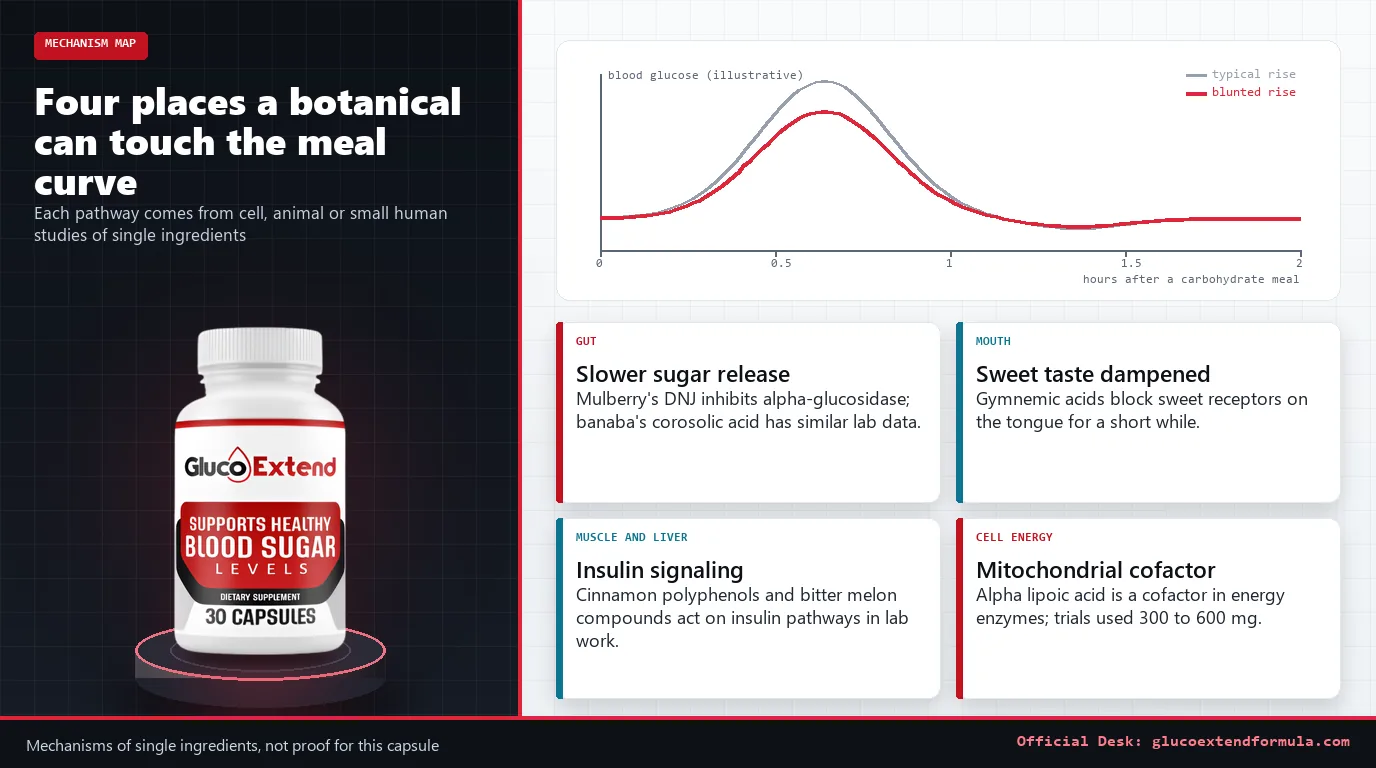
The glucose curve in one minute
Blood glucose has two numbers that matter for everyday health. The fasting level, measured after at least eight hours without food, reflects how well the liver holds back glucose overnight and how sensitive the body is to insulin. The after-meal level shows what happens when food arrives: carbohydrate is broken down to glucose in the gut, absorbed, and cleared from the blood by insulin pushing it into muscle, liver and fat. In people without diabetes, glucose usually peaks within an hour of a meal and is back under 140 mg/dL by two hours[1][2].
Insulin resistance, the condition behind most prediabetes, makes both numbers creep up: the liver releases more glucose overnight, and muscle takes up less after meals, so the curve rises higher and falls slower[3]. A supplement can, in theory, act at four points on that curve: how fast sugar is released in the gut, how sweet food tastes and how much is eaten, how strongly insulin signals in tissues, and how efficiently cells burn glucose. Gluco Extend's ingredients map onto all four, which is the best case for the formula. The rest of this page checks each link in the chain against the evidence.
Fasting glucose is a different problem
The after-meal curve and the fasting number are related but not the same. Overnight, the liver keeps glucose steady by releasing stored and newly made glucose, and insulin's job is to keep that release in check. When the liver becomes insulin resistant, it overproduces glucose while you sleep, and the fasting reading rises even if your meals are modest. Many people also see a "dawn" bump in the early morning, driven by hormones that prepare the body to wake.
That distinction matters for reading the evidence. Mulberry leaf and banaba mainly act on what happens after a meal, and their studies measured after-meal glucose[4][9]. Cinnamon's meta-analyses found an effect on fasting glucose but not on A1C[16], while alpha lipoic acid and bitter melon studies reported small fasting changes[20][18]. A product that mixes both kinds of ingredient at small doses may nudge one number without moving the other, so track both: a fasting reading on waking and a reading two hours after your largest meal.
The A1C test, which reflects average glucose over roughly three months, is the number your clinician will use, and it needs a full three months to show any change[1]. That is one more reason to plan a trial of at least twelve weeks and to keep the refund deadline in view.
Pathway 1: slower sugar release in the gut
Carbohydrates are not absorbed as starch or table sugar. Enzymes on the lining of the small intestine, called alpha-glucosidases, cut them into glucose first. Slow those enzymes and less glucose arrives at once, so the after-meal peak is lower and later. This is how the prescription drug acarbose works.
Mulberry leaf's DNJ does the same job. Taken with a sugar load, mulberry extract lowered the glucose and insulin rise in several controlled studies[4][5][6][7], and pooled analysis found the most reliable effect on post-meal readings[8]. The first of those studies also measured breath hydrogen, which rose because unabsorbed sugar was fermented in the colon; that is the mechanism working, and also why gas and bloating are its typical side effects. Banaba's corosolic acid has related enzyme and glucose-transport activity in lab models, and lowered glucose in short human tests[9][10].
What it implies for use: this pathway only works when the ingredient meets the meal. A capsule taken on an empty stomach in the morning, hours before a starchy lunch, would do little here.
Pathway 2: taste, appetite and absorption
Gymnema's gymnemic acids are shaped enough like sugar to occupy the sweet receptor on the tongue, so sweet foods temporarily taste flat[11]. Some studies suggest that this reduces how much sweet food people choose afterward. Lab work adds possible effects on intestinal glucose uptake and on the insulin-producing beta cells of the pancreas.
In people, the longest study used 400 mg a day of a defined leaf extract for 18 to 20 months and saw lower fasting glucose and A1C[12]. A meta-analysis supports a modest effect[13], while a 12-week randomized trial at 600 mg a day changed body weight and VLDL but not insulin sensitivity or secretion[14]. The taste mechanism needs contact with the tongue; in a swallowed capsule, only the internal effects remain.
Pathway 3: insulin signaling in muscle and liver
Once glucose is in the blood, insulin has to tell muscle and liver cells to take it up. Cinnamon polyphenols and compounds from bitter melon act on this signaling chain in cell and animal studies, increasing glucose transporter activity. Cinnamon also slows stomach emptying, which spreads the arrival of glucose: 6 grams with a rice pudding reduced the after-meal rise in healthy volunteers[15].
Human outcomes over weeks are modest. Cinnamon trials lowered fasting glucose without a reliable A1C change[16][17]. Bitter melon's pooled data show small improvements[19], and its best direct trial needed 2,000 mg a day to register an effect that was smaller than a low dose of metformin[18]. This pathway is the most plausible on paper and the most dose-hungry in practice.
Pathway 4: cellular fuel and oxidative stress
Alpha lipoic acid works inside the cell. It is a required cofactor for the mitochondrial enzymes that feed glucose-derived fuel into energy production, and it recycles other antioxidants. High glucose generates oxidative stress, so an antioxidant that also supports glucose use is an attractive idea.
At 300 mg a day for eight weeks, ALA lowered fasting glucose and insulin resistance in adults with type 2 diabetes[20], and a meta-analysis found small improvements in several glucose markers[21]. Its clearest clinical role is in nerve symptoms rather than glucose. As with the other pathways, the doses studied are hundreds of milligrams of ALA alone.
What DGL, yarrow, juniper and mulberry fruit add
Four of the ten names have no recognized glucose mechanism in human research. DGL licorice is used for stomach comfort, yarrow and juniper berry for traditional digestive and urinary purposes, and mulberry fruit is a berry with sugars and pigments. They may make the formula gentler on the stomach or add antioxidant polyphenols, but they do not add a fifth pathway, and every milligram they occupy is a milligram not available for the ingredients with glucose data.
That is the hidden cost of long ingredient lists in a single capsule. A formula with three well-dosed, standardized ingredients would usually be easier to evaluate, and more likely to reach research levels, than one with ten unquantified names.
Synergy: the claim and the test
Multi-ingredient formulas often rely on the idea of synergy: several mild effects at different points adding up, or even multiplying. In pharmacology, synergy is a measurable thing. You test each ingredient alone and in combination and show that the combination does more than the sum. That has not been done for Gluco Extend or, as far as we can find, for this combination of botanicals.
A fair test would be simple to design: a randomized, placebo-controlled trial in adults with prediabetes, the exact capsule taken daily for twelve weeks, with fasting glucose, a standard meal test and A1C as outcomes. Until something like that exists, the most accurate statement is that each ingredient has a plausible mechanism and partial human evidence at its own dose, and that the blend's effect is unknown.
How to see your own curve
The point of understanding the mechanism is to know what to measure. A finger-stick meter is enough for a fair personal test: check fasting on waking and two hours after the same evening meal on three different days, before you start and again after eight to twelve weeks, keeping the meal and the post-meal walk the same. Write down what you ate. If you want more detail, an over-the-counter continuous glucose monitor shows the whole after-meal curve, including how high it peaks and how fast it falls[25].
Read the results with care. Day-to-day variation of 10 to 20 mg/dL is normal, especially after meals, so a single lower reading means little. A consistent shift across several matched days is what to look for, and anything that changes how you take your medicines is a conversation for your clinician, not a conclusion from your meter.
Mechanism map
| Step on the curve | Ingredient | Mechanism | Human evidence | Dose studied |
|---|---|---|---|---|
| Gut digestion | Mulberry leaf | Alpha-glucosidase inhibition (DNJ) | Several controlled meal studies | About 1 g extract with the meal |
| Gut digestion | Banaba | Corosolic acid, enzyme and transport effects | Two small short studies | 32 to 48 mg extract; 10 mg corosolic acid |
| Taste and intake | Gymnema | Sweet receptor block; possible beta-cell effects | Long-term open study; meta-analysis | 400 to 600 mg extract |
| Insulin signaling | Cassia cinnamon | Polyphenols; slower gastric emptying | Meta-analyses, fasting glucose only | 120 mg to 6 g |
| Insulin signaling | Bitter melon | Charantin, polypeptide-p | Meta-analyses, low quality | 2,000 mg dried fruit |
| Cell energy | Alpha lipoic acid | Mitochondrial cofactor, antioxidant | Randomized trials, meta-analysis | 300 to 600 mg |
| None established | DGL, yarrow, juniper, mulberry fruit | Digestive or traditional | No glucose trials found | Not applicable |
The bigger levers, for scale
Supplements are easiest to judge against things that are known to move the curve. In the Diabetes Prevention Program, a lifestyle program aiming for 7 percent weight loss and 150 minutes of weekly activity reduced the progression from prediabetes to diabetes by 58 percent[22]. Eating vegetables and protein before carbohydrate at the same meal lowered the glucose peak substantially in a crossover study[23], and splitting walking into ten minutes after each meal lowered after-meal glucose more than one daily walk[24].
Those effects are larger, better documented and free. If you take Gluco Extend, keep them; they also make your before-and-after comparison fairer, because the only thing that changes is the capsule. A continuous glucose monitor, now available over the counter, can show your own after-meal curves in detail[25], and NCCIH's advice applies: no supplement should replace proven diabetes care[26].
Questions on this topic
Does Gluco Extend lower blood sugar immediately?
No such effect has been shown. The ingredient with the most direct after-meal evidence, mulberry leaf, works only when taken with the meal and at about a gram of extract. Any effect from a share of one capsule is likely to be small.
Is it better to take Gluco Extend before or with meals?
With your largest meal. The gut-level ingredients, mulberry and banaba, act on the carbohydrate in that meal; taken hours earlier, they have nothing to act on.
Does Gluco Extend work like metformin?
No. Metformin mainly reduces glucose release by the liver and has decades of outcome data. Bitter melon at 2,000 mg a day did less than 1,000 mg of metformin in a head-to-head trial, and one capsule cannot hold that much.
Can Gluco Extend reverse insulin resistance?
There is no evidence that it can. Weight loss, physical activity and sleep have the strongest evidence for improving insulin sensitivity.
Why does mulberry cause gas?
Because it works by slowing sugar digestion. Some carbohydrate reaches the colon undigested, where bacteria ferment it into hydrogen and other gases.
Records cited on this page
Every link opens the original record. The trials tested single botanicals at stated doses and preparations; none tested the Gluco Extend capsule, whose amounts are not published.
- 1American Diabetes Association Professional Practice Committee. 2. Diagnosis and classification of diabetes: Standards of Care in Diabetes-2025. Diabetes Care. 2025;48(Suppl 1):S27-S49. pubmed.ncbi.nlm.nih.gov/39651986/
- 2MedlinePlus Medical Encyclopedia, U.S. National Library of Medicine. Blood sugar test. medlineplus.gov/ency/article/003482.htm
- 3National Institute of Diabetes and Digestive and Kidney Diseases. Insulin Resistance & Prediabetes. www.niddk.nih.gov/health-information/diabetes/overview/what-is-diabetes/prediabetes-insulin-resistance
- 4Mudra M, Ercan-Fang N, Zhong L, Furne J, Levitt M. Influence of mulberry leaf extract on the blood glucose and breath hydrogen response to ingestion of 75 g sucrose by type 2 diabetic and control subjects. Diabetes Care. 2007;30(5):1272-1274. pubmed.ncbi.nlm.nih.gov/17303787/
- 5Kimura T, Nakagawa K, Kubota H, et al. Food-grade mulberry powder enriched with 1-deoxynojirimycin suppresses the elevation of postprandial blood glucose in humans. J Agric Food Chem. 2007;55(14):5869-5874. pubmed.ncbi.nlm.nih.gov/17555327/
- 6Lown M, Fuller R, Lightowler H, et al. Mulberry-extract improves glucose tolerance and decreases insulin concentrations in normoglycaemic adults: results of a randomised double-blind placebo-controlled study. PLoS One. 2017;12(2):e0172239. pubmed.ncbi.nlm.nih.gov/28225835/
- 7Thondre PS, Lightowler H, Ahlstrom L, Gallagher A. Mulberry leaf extract improves glycaemic response and insulaemic response to sucrose in healthy subjects: results of a randomized, double blind, placebo-controlled study. Nutr Metab (Lond). 2021;18(1):41. pubmed.ncbi.nlm.nih.gov/33858439/
- 8Cui W, Luo K, Xiao Q, et al. Effect of mulberry leaf or mulberry leaf extract on glycemic traits: a systematic review and meta-analysis. Food Funct. 2023;14(3):1277-1289. pubmed.ncbi.nlm.nih.gov/36644880/
- 9Judy WV, Hari SP, Stogsdill WW, et al. Antidiabetic activity of a standardized extract (Glucosol) from Lagerstroemia speciosa leaves in Type II diabetics. A dose-dependence study. J Ethnopharmacol. 2003;87(1):115-117. pubmed.ncbi.nlm.nih.gov/12787964/
- 10Fukushima M, Matsuyama F, Ueda N, et al. Effect of corosolic acid on postchallenge plasma glucose levels. Diabetes Res Clin Pract. 2006;73(2):174-177. pubmed.ncbi.nlm.nih.gov/16549220/
- 11Kanetkar P, Singhal R, Kamat M. Gymnema sylvestre: a memoir. J Clin Biochem Nutr. 2007;41(2):77-81. pubmed.ncbi.nlm.nih.gov/18193099/
- 12Baskaran K, Kizar Ahamath B, Radha Shanmugasundaram K, Shanmugasundaram ER. Antidiabetic effect of a leaf extract from Gymnema sylvestre in non-insulin-dependent diabetes mellitus patients. J Ethnopharmacol. 1990;30(3):295-300. pubmed.ncbi.nlm.nih.gov/2259217/
- 13Devangan S, Varghese B, Johny E, et al. The effect of Gymnema sylvestre supplementation on glycemic control in type 2 diabetes patients: a systematic review and meta-analysis. Phytother Res. 2021;35(12):6802-6812. pubmed.ncbi.nlm.nih.gov/34467577/
- 14Zuñiga LY, González-Ortiz M, Martínez-Abundis E. Effect of Gymnema sylvestre administration on metabolic syndrome, insulin sensitivity, and insulin secretion. J Med Food. 2017;20(8):750-754. pubmed.ncbi.nlm.nih.gov/28459647/
- 15Hlebowicz J, Darwiche G, Björgell O, Almér LO. Effect of cinnamon on postprandial blood glucose, gastric emptying, and satiety in healthy subjects. Am J Clin Nutr. 2007;85(6):1552-1556. pubmed.ncbi.nlm.nih.gov/17556692/
- 16Allen RW, Schwartzman E, Baker WL, Coleman CI, Phung OJ. Cinnamon use in type 2 diabetes: an updated systematic review and meta-analysis. Ann Fam Med. 2013;11(5):452-459. pubmed.ncbi.nlm.nih.gov/24019277/
- 17Leach MJ, Kumar S. Cinnamon for diabetes mellitus. Cochrane Database Syst Rev. 2012;(9):CD007170. pubmed.ncbi.nlm.nih.gov/22972104/
- 18Fuangchan A, Sonthisombat P, Seubnukarn T, et al. Hypoglycemic effect of bitter melon compared with metformin in newly diagnosed type 2 diabetes patients. J Ethnopharmacol. 2011;134(2):422-428. pubmed.ncbi.nlm.nih.gov/21211558/
- 19Peter EL, Kasali FM, Deyno S, et al. Momordica charantia L. lowers elevated glycaemia in type 2 diabetes mellitus patients: systematic review and meta-analysis. J Ethnopharmacol. 2019;231:311-324. pubmed.ncbi.nlm.nih.gov/30385422/
- 20Ansar H, Mazloom Z, Kazemi F, Hejazi N. Effect of alpha-lipoic acid on blood glucose, insulin resistance and glutathione peroxidase of type 2 diabetic patients. Saudi Med J. 2011;32(6):584-588. pubmed.ncbi.nlm.nih.gov/21666939/
- 21Akbari M, Ostadmohammadi V, Lankarani KB, et al. The effects of alpha-lipoic acid supplementation on glucose control and lipid profiles among patients with metabolic diseases: a systematic review and meta-analysis of randomized controlled trials. Metabolism. 2018;87:56-69. pubmed.ncbi.nlm.nih.gov/29990473/
- 22Knowler WC, Barrett-Connor E, Fowler SE, et al. Reduction in the incidence of type 2 diabetes with lifestyle intervention or metformin. N Engl J Med. 2002;346(6):393-403. pubmed.ncbi.nlm.nih.gov/11832527/
- 23Shukla AP, Iliescu RG, Thomas CE, Aronne LJ. Food order has a significant impact on postprandial glucose and insulin levels. Diabetes Care. 2015;38(7):e98-e99. pubmed.ncbi.nlm.nih.gov/26106234/
- 24Reynolds AN, Mann JI, Williams S, Venn BJ. Advice to walk after meals is more effective for lowering postprandial glycaemia in type 2 diabetes mellitus than advice that does not specify timing: a randomised crossover study. Diabetologia. 2016;59(12):2572-2578. pubmed.ncbi.nlm.nih.gov/27747394/
- 25National Institute of Diabetes and Digestive and Kidney Diseases. Continuous Glucose Monitoring. www.niddk.nih.gov/health-information/diabetes/overview/managing-diabetes/continuous-glucose-monitoring
- 26National Center for Complementary and Integrative Health. Diabetes and Dietary Supplements. www.nccih.nih.gov/health/diabetes-and-dietary-supplements
Give Gluco Extend a measured, six-month trial
ClickBank processes the order. Write down a few fasting and after-dinner readings before the first capsule, keep the walk after meals and the vegetables-first plate, save the receipt email, and if your numbers and your doctor see no change by the fifth month, send the bottles back while the window is still open.